
Fathimath Jila Shameem
Optic disc coloboma is a rare congenital anomaly of the optic nerve head caused by partial or complete failure of closure of the embryonic fissure (1). It is characterised by a sharply demarcated, bowl-shaped excavation that replaces part of the optic disc (2). The defect most commonly involves the inferior nasal aspect of the disc and may extend to involve the retina, uvea, and sclera (3). The condition may be unilateral or bilateral and typically occurs sporadically in otherwise healthy individuals; however, some of the systemic associations reported include renal coloboma syndrome, CHARGE association, and Aicardi syndrome (1,3,4). An autosomal dominant form has been linked to mutations in the PAX6 gene (4).
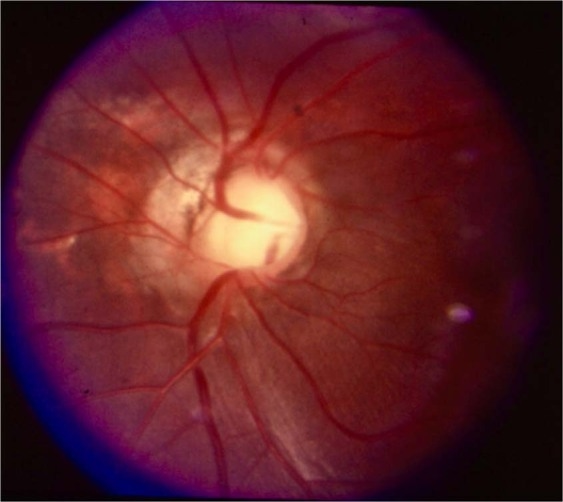
Lingam et al under Creative Commons (CC BY 4.0)
The degree of visual impairment caused by coloboma ranges from asymptomatic to complete vision loss, depending on the defect’s size and anatomical location (1). Visual acuity is often reduced and may be associated with amblyopia and refractive error (4). The visual field shows a superior defect (4). Fundus examination appears as a focal, glistening white, bowl-shaped excavation located inferiorly, with normal disc tissue limited to the superior wedge, depending on the severity (2–4). A pit-like excavation may sometimes be seen with disc coloboma(4). Swept-source optical coherence tomography (OCT) has demonstrated sparsely arranged, disorganised scleral fibres with defects that allow communication with the subarachnoid space and the base of the coloboma excavation (5).
There is no specific treatment for optic disc coloboma. Management focuses on monitoring, correcting refractive errors, and treating complications such as retinal detachment (3). Early recognition, appropriate investigation, and long-term follow-up are essential to optimise visual outcomes and identify associated systemic conditions.
References
1. Vegunta S, Patel BC. Optic Nerve Coloboma. Handbook of Pediatric Retinal OCT and the Eye-Brain Connection [Internet]. 2023 Jun 26 [cited 2025 Dec 15];278–81. Available from: https://www.ncbi.nlm.nih.gov/books/NBK532877/
2. Lingam G, Sen AC, Lingam V, Bhende M, Padhi TR, Xinyi S. Ocular coloboma—a comprehensive review for the clinician. Vol. 35, Eye (Basingstoke). Springer Nature; 2021. p. 2086–109.
3. Amador-Patarroyo MJ, Pérez-Rueda MA, Tellez CH. Congenital anomalies of the optic nerve. Saudi Journal of Ophthalmology [Internet]. 2014 Jan 1 [cited 2025 Dec 15];29(1):32. Available from: https://pmc.ncbi.nlm.nih.gov/articles/PMC4314572/
4. Bowling B. Kanski’s Clinical Ophthalmology, Eighth Edition (2016). 2016.
5. Optic Nerve Coloboma Spectrum – EyeWiki [Internet]. [cited 2025 Dec 16]. Available from: https://eyewiki.org/Optic_Nerve_Coloboma_Spectrum#cite_note-ohnomatsui8-9