Anes Harid
Introduction
Charles Bonnet syndrome (CBS) is one of the clearest examples of why the eye and the mind cannot be treated as separate systems. It describes recurrent visual hallucinations in people with visual impairment, usually with preserved insight and without hallucinations in other sensory modalities, dementia or primary psychosis (1). The hallucinations may be simple shapes, colours or patterns, or complex images of faces, animals, figures, landscapes and scenes. They may last minutes or hours, appear suddenly, and be moving or still (2). The mechanism is commonly explained through “release” or deafferentation: when reduced visual input leaves the visual cortex under-stimulated, spontaneous activity may be experienced as images (1). Yet this explanation, though reassuring, is incomplete unless it is linked to lived experience.
Recognising an Under-Discussed Condition
CBS is common enough that it should be anticipated in eye care. A recent systematic review and meta-analysis estimated an overall prevalence of about 10% among ophthalmic patients, rising in low-vision and vision rehabilitation populations (3). UK guidance published in 2026 notes that up to one in five people with visual impairment may experience CBS during their sight-loss journey (1). Despite this, CBS remains under-recognised. Many patients do not volunteer their symptoms because “seeing things” is culturally associated with mental illness, dementia, delirium or loss of capacity. For some, the greatest burden is not the image itself, but the fear of what disclosure might cost: independence, credibility, a driving licence, or being believed.
The biological burden of CBS
The biopsychosocial challenges of CBS begin with biology but do not end there. Biologically, people may already be adapting to macular degeneration, glaucoma, cataract, diabetic eye disease, inherited retinal disease or neurological visual loss. Hallucinations can further reduce confidence in mobility, cooking, reading, sleeping and navigating unfamiliar environments. They can also overlap with clinical complexity: infection, medication adverse effects, migraine aura, retinal detachment, cognitive impairment, delirium and psychosis must be considered when presentations are atypical (1,2). A patient with insight and purely visual symptoms may need reassurance; a patient with new confusion, loss of insight or multimodal hallucinations may need urgent medical, neurological or psychiatric assessment. This diagnostic boundary is precisely where ophthalmology and psychiatry must communicate.
Psychological Impact and Lived Experience
Psychologically, CBS is heterogeneous. Some people find the images neutral or even intriguing. Others describe terrifying figures, repeated scenes or intrusive images that feel like a “horror film”. The same syndrome can therefore be mildly inconvenient for one person and disabling for another. Studies of the psychosocial impact of CBS describe distress, fear, shame, reduced quality of life and difficulty completing everyday tasks (4). In a 2024 study of 126 adults with CBS, 55% rated its impact as negative; negative affect correlated with more negative appraisal of CBS and with loneliness (5). These findings matter because they challenge a purely educational model of care. Reassurance that CBS is “not psychosis” is essential, but it is not always enough. The emotional meaning of the hallucination, the patient’s prior experiences of mental illness or dementia, and the support available at home can all change the clinical impact.
Social Inequalities and Barriers to Care
Socially, CBS can deepen existing inequalities. It often affects older adults, a group already at risk of loneliness, falls, sensory impairment and fragmented care. But it is not confined to old age: children, working-age adults and visually impaired veterans have also been described in recent research (1). People living alone may have fewer opportunities to reality-check hallucinations or seek help. People with low health literacy, language barriers or mistrust of services may be less likely to receive an explanation. Digital exclusion can limit access to online information and peer support. Meanwhile, access to low-vision rehabilitation, psychological therapy and ophthalmology follow-up varies by geography, socioeconomic status and service capacity. CBS therefore exposes an equity problem: the people most likely to need coordinated care may be least able to request it. (Figure 1)
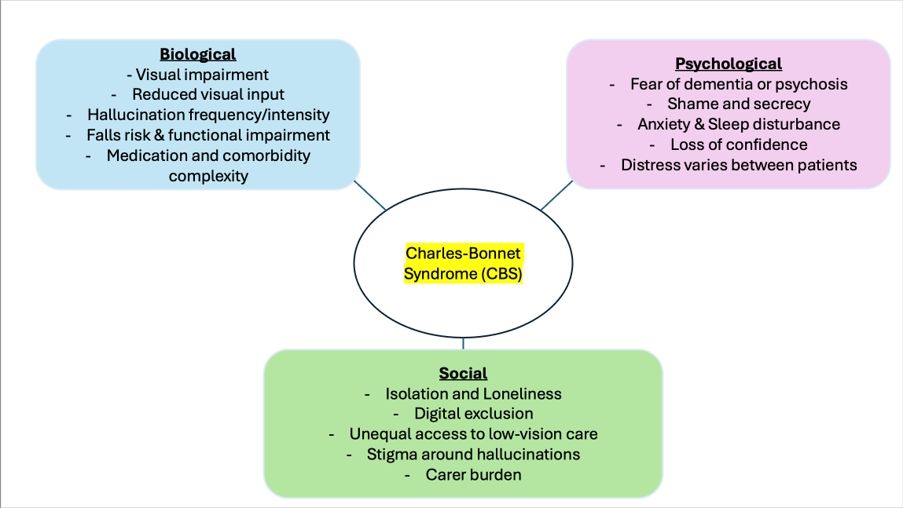
Figure 1. Biopsychosocial burden of Charles Bonnet syndrome. CBS begins with visual impairment, but its impact is shaped by psychological distress, stigma, loneliness, service access and wider social inequalities. This variation explains why care must be personalised rather than limited to reassurance alone (1,4,5).
Personalised Multidisciplinary Care
Personalised multidisciplinary care is the answer, but it must be practical. A good pathway begins before disclosure. Eye clinics, optometrists, GPs and low-vision services should normalise CBS by saying: “Some people with sight loss see things that are not really there. Has this happened to you?” This question reduces stigma and creates permission to speak. If hallucinations are present, clinicians should document visual status, onset, content, duration, triggers, insight, emotional impact, medication changes, cognition and safety concerns. Reversible visual causes should be treated where possible, including cataract or active retinal disease. Medication review with the GP is important, particularly for drugs that can precipitate confusion or visual phenomena. (Figure 2)
Managing CBS Through Education, Rehabilitation and Advocacy
Management should then be stepped. For many people, education is therapeutic: naming CBS, explaining that it is a recognised consequence of visual loss, and offering written information can reduce fear. Behavioural strategies can be tailored to triggers: changing lighting, moving rooms, standing up, using distraction, improving sleep, reducing stress, or using eye-movement exercises during an episode (1,2). Low-vision rehabilitation may improve the person’s remaining functional vision and confidence. Peer support is equally clinical in its effect, because it turns a private fear into a shared, named experience. Esme’s Umbrella is a powerful example of advocacy becoming care: the charity raises awareness, supports people and families, works with the RNIB helpline and Esme’s Friends groups, and campaigns for professional education and research (6,7).
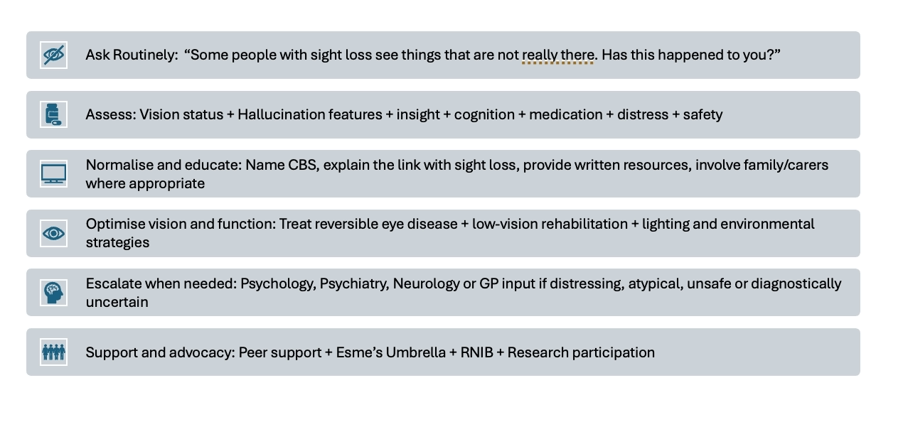
Figure 2: A stepped multidisciplinary approach to CBS care. Routine questioning can reduce stigma and uncover hidden symptoms. Management should then be tailored to visual function, distress, risk, comorbidity and the patient’s social context (1,6,7)
When Reassurance Is Not Enough
For patients with “negative-outcome” CBS from frequent, frightening or disabling hallucinations, ophthalmology should not simply discharge with reassurance. Referral to psychology, psychiatry, neurology or older-adult services may be appropriate depending on distress, risk, cognition and diagnostic uncertainty. Talking therapies, especially interventions adapted for sight loss, may help people reinterpret hallucinations, manage anxiety and rebuild routines. Pharmacological treatment should remain cautious: case reports describe benefit from anticonvulsants, antidepressants, antipsychotics and cholinesterase inhibitors, but evidence is limited and side effects may be substantial in older patients (1). Neuromodulation, including transcranial direct current stimulation, has shown promise but remains investigational (8).
Research Priorities and Specific Interventions
Research now needs to move from describing CBS to testing specific interventions. First, routine screening should be evaluated in real-world ophthalmology and optometry clinics: does a one-question prompt increase disclosure, reduce distress and prevent unnecessary psychiatric referrals? Second, psychoeducational toolkits should be co-designed for different groups: older adults living alone, children, veterans, people with dementia risk, and communities whose first language is not English. Third, psychological interventions need trials with CBS-specific outcomes: frequency and distress of hallucinations, loneliness, sleep, falls confidence, quality of life and caregiver burden. Fourth, low-vision rehabilitation should be studied not only as visual support but as a hallucination-management intervention. Fifth, research should test peer-support models, including telephone groups for those digitally excluded. Finally, neuromodulation and medication trials should include patient-selected outcomes and stratify by hallucination type, visual diagnosis, distress level and comorbidity, so treatment becomes personalised rather than experimental guesswork.
Conclusion
CBS sits at a neglected intersection: not quite an eye disease, not quite a psychiatric disorder, and therefore too easily owned by no one. But for the person seeing children in the hallway, insects on the table or strangers at the bedside, professional boundaries are irrelevant. What matters is being asked, believed, reassured, assessed and supported. The future of CBS care should be proactive, multidisciplinary and equitable: ophthalmology to recognise and optimise sight, psychiatry and psychology to address distress and uncertainty, primary care to coordinate safety and medicines, low-vision services to restore function, and advocates to keep lived experience at the centre. CBS is not simply “seeing things”. It is a test of whether medicine can see the whole person.
References
1. Jones L, ffytche DH, Moosajee M. Management of Charles Bonnet syndrome in routine eye care services. Eye. 2026;40:446-448. doi:10.1038/s41433-025-04215-0.
2. NHS. Charles Bonnet syndrome (Internet). London: NHS; 2026 (cited 2026 Jul 8).
3. Christoph SEG, Boden KT, Siegel R, Seitz B, Szurman P, Schulz A. The prevalence of Charles-Bonnet syndrome in ophthalmic patients: a systematic review and meta-analysis. Brain Res Bull. 2025;223:111282.
4. Jones L, Ditzel-Finn L, Enoch J, Moosajee M. An overview of psychological and social factors in Charles Bonnet syndrome. Ther Adv Ophthalmol. 2021;13:25158414211034715. doi:10.1177/25158414211034715.
5. Higgins B, Taylor D, Crabb D, Callaghan T. Emotional well-being in Charles Bonnet syndrome: exploring associations with negative affect, loneliness and quality of life. Ther Adv Ophthalmol. 2024;16:25158414241275444. doi:10.1177/25158414241275444.
6. Jones L, Jolly JK, Potts J, Callaghan T, Fisher K, Ip IB, et al. From research to action: recommendations for Charles Bonnet syndrome care and policy. BMJ Open Ophthalmol. 2025;10:e002009. doi:10.1136/bmjophth-2024-002009.
7. Esme’s Umbrella. What we do. London: Esme’s Umbrella;.
8. DaSilva Morgan K, Schumacher J, Collerton D, Colloby S, Elder GJ, Olsen K, et al. Transcranial direct current stimulation in the treatment of visual hallucinations in Charles Bonnet syndrome: a randomized placebo-controlled crossover trial. Ophthalmology. 2022;129:1368-1379.